News
We don’t expect success, we work for it. Become a part of an amazing team!
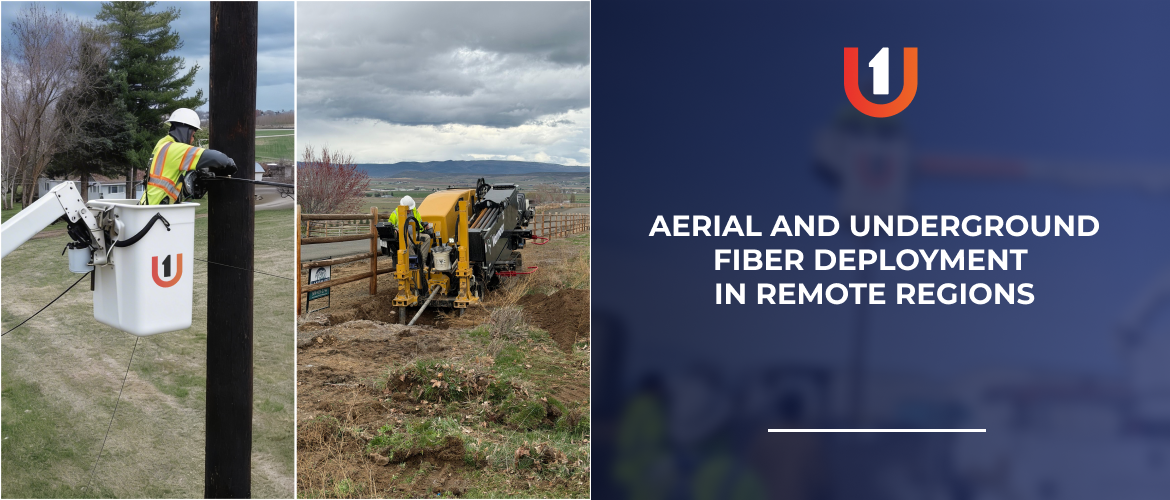
Aerial and Underground Fiber Deployment in Remote Regions
Network expansion in remote areas requires a controlled, methodical approach that aligns engineering design with field conditions. Unlike urban environments, rural deployments involve longer distances, limited infrastructure, and variable terrain, all of which directly influence execution strategy.
Utilities One Group approaches these projects through a structured deployment model that integrates both aerial and underground fiber installations, ensuring coverage, performance, and long-term reliability across every segment of the network.
Key Deployment Challenges
Remote infrastructure projects are shaped by a combination of distance, terrain, and infrastructure limitations. Extended spans between connection points require precise routing and signal continuity planning, while the absence of existing infrastructure often necessitates full-scale builds rather than incremental upgrades.
Terrain variability and environmental exposure further influence execution, affecting both access to installation points and the long-term durability of the network. Addressing these factors early in the planning phase enables a controlled, predictable deployment process.
Aerial Fiber Deployment
Aerial fiber deployment is a primary method for extending networks across rural areas where existing utility poles are available. This approach provides efficient coverage over long distances while minimizing ground disturbance and reducing the need for extensive civil work.
Field execution involves structured installation processes, including cable placement, tensioning, hardware installation, and alignment along pole infrastructure. Each segment is verified on-site to ensure proper configuration and signal performance before proceeding.
The effectiveness of aerial deployment is defined by its ability to accelerate timelines while maintaining installation quality, making it a practical solution for large-scale rural expansion.
Underground Fiber Deployment
Underground fiber installation is applied in areas where aerial routing is not feasible or where additional protection is required. This includes crossings of roads and private property, as well as locations where environmental or structural considerations limit above-ground deployment.
Horizontal Directional Drilling (HDD) is commonly used to execute these installations with precision and minimal surface disruption. The process involves detailed route planning, controlled drilling, and the placement of conduit and fiber infrastructure below ground, followed by thorough testing and validation.
This method provides greater protection against environmental exposure and external damage, contributing to long-term network stability and reduced maintenance requirements.
Integrated Deployment Strategy
Successful network expansion in remote areas depends on combining aerial and underground methods within a single, coordinated strategy. Each segment of the network is evaluated based on terrain conditions, accessibility, infrastructure availability, and permitting requirements to determine the most effective approach.
This integrated model optimizes routing across varying environments while balancing execution efficiency, cost control, and infrastructure durability. The result is a network designed to perform consistently across diverse field conditions.
Execution and Field Coordination
Execution in remote environments requires disciplined coordination across engineering, logistics, and field operations. Planning must remain closely aligned with actual site conditions to ensure that resources are deployed effectively and that installation progresses without disruption.
Core execution principles include:
-
Alignment between engineering design and field conditions
-
Structured allocation of crews, equipment, and materials
-
Continuous verification during installation
-
Final validation to confirm performance and reliability
This structured approach enables Utilities One Group to maintain control over quality, timelines, and overall project outcomes.
Conclusion
Expanding fiber infrastructure into remote areas requires a precise balance between speed, protection, and long-term performance. Aerial and underground deployment methods serve as complementary components within a unified execution framework.
Through structured planning, coordinated field operations, and disciplined execution, Utilities One Group delivers scalable, reliable network infrastructure, ensuring high-quality connectivity reaches even the most remote locations.
Share Via:
Related Posts


300 W Somerdale Rd, Suite 5E, Voorhees Township, NJ 08043
COPYRIGHT © 2026 UTILITIES ONE